Co-Creation in Action: How Share-Net Bangladesh is Reimagining SRHR Knowledge Through Collaboration
Introduction
At Share-Net Bangladesh, our commitment to advancing Sexual and Reproductive Health and Rights (SRHR) is grounded in synergy, innovation, and the belief that knowledge thrives when it is shared. For years, we have worked to make SRHR knowledge accessible, inclusive, and rooted in lived experience. Yet opportunities to co-build that knowledge, across borders, disciplines, and identities, are rare.
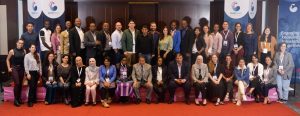
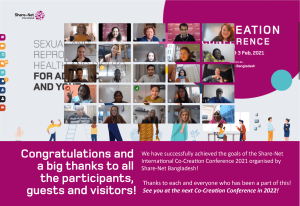
This changed through our engagement with the Co‑Creation Conference under Share-Net International. The Co-Creation Conference was not just a gathering of professionals; it was a turning point in how we understand collaborative knowledge generation. Bringing together hubs from Bangladesh, Jordan, Colombia, Burundi, and the Netherlands, the Co-Creation Conference functioned as a creative lab, an experimentation space, and a reflective ground for rethinking SRHR knowledge products.
In this blog, we share how we navigated the co-creation process, what we learned through global and regional collaboration, and how it is redefining our approach to producing meaningful SRHR knowledge in Bangladesh.
Setting the Stage: The CCC Experience
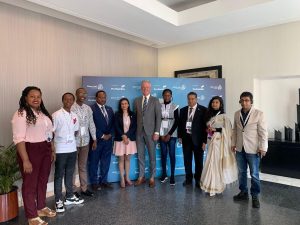
The Co-Creation Conference brought together representatives from all Share-Net International hubs alongside artists, facilitators, development practitioners, and SRHR experts. Our delegation from Share-Net Bangladesh included Knowledge Management Expert Jannatul Munia, Project Director Arnob Chakraborty, and development professional Tasnia Ahmed—each contributing different perspectives shaped by field experience, community engagement, and SRHR policy work.
Together, we aimed to explore how co-creation could address urgent SRHR challenges in Bangladesh through a process that was participatory, culturally grounded, and creatively inspired. The environment encouraged everyone to bring their full selves into the room, and for us, that meant carrying the voices of the hijra community, rural youth, health service seekers, and grassroots facilitators into the conversation.
Identifying the Core Issue: A Participatory Approach
The theme we brought to the Co-Creation Conference reflected a deeply felt gap within Bangladesh’s SRHR ecosystem: the invisibility and systemic exclusion faced by gender-diverse communities, particularly hijra and third-gender groups, in healthcare and social services. This issue emerged from our ongoing dialogues and small group consultations across several districts—an approach Share-Net Bangladesh has strengthened through its 10-year reflection process and community-based knowledge generation activities.
The Co-Creation Conference validated these ground-up processes. Instead of imposing external themes, the conference emphasised that each hub should bring forward issues identified through local engagement. For us, this reinforced our belief that knowledge must begin with those whose experiences are overlooked in policy and programming.
A Participatory and Purposeful Process
The co-creation methodology at the Co-Creation Conference mirrored our own knowledge practices at Share-Net Bangladesh: iterative cycles of listening, ideation, reflection, and redesign. Rather than formal research protocols, the process centred on accessibility, creativity, and shared ownership. Lived experiences were treated as expertise. Cultural nuances were seen as assets. And collaboration replaced hierarchy.
This approach resonated strongly with Share-Net Bangladesh’s work, especially our Knowledge Fairs, regional sessions, and youth dialogues. In recent years, our parallel sessions have brought together academia, development organisations, grassroots organisations, journalists, and health professionals, mirroring the very diversity reflected in the Co-Creation Conference environment.
From Ideas to Action: Co-Creating Knowledge Products
Initially, our team envisioned a policy brief aimed at improving service delivery for gender-diverse communities. But co-creation thrives on transformation, and as we exchanged ideas with other hubs, our direction shifted organically.
The Colombian team’s use of gamification for youth SRHR education, the Jordan team’s use of localised illustrations, and Burundi’s emphasis on community-led storytelling encouraged us to rethink our approach. By the end of Day 2, we developed a prototype for a layered, user-friendly visual explainer designed for policymakers, health providers, and gender-diverse community members.
The strength of this product was not only its format but its process, born out of collaboration, adapted for Bangladesh, and inspired by methods from across the Share-Net International network.
What Makes Co-Creation Different?
Co-creation differs from traditional knowledge production. Instead of relying solely on research, it draws on multidisciplinary skills, art, creativity, communication, and centers people who often remain on the periphery.
During the Co-Creation Conference, we used creative tools such as storyboarding, persona mapping, rapid prototyping, and peer critique circles. These methods helped us challenge assumptions and create content that is both accurate and emotionally resonant.
Cross-country exchanges were among the most enriching aspects. We learned how Share-Net Jordan’s regional curriculum work integrates Comprehensive Sexuality Education, how Colombia uses comics to communicate abortion rights, and how Burundi mobilises youth networks. These insights opened new pathways to explore within Share-Net Bangladesh’s programmes—especially our collaborations with youth clubs, community journalists, and local government actors.
Challenges and Lessons Learned
Co-creation is fluid and dynamic, but it is also demanding. Tight timelines, diverse cultural styles, and varying creative instincts required patience and flexibility. Early on, we struggled to select a format that could speak to multiple audiences without diluting its focus.
A breakthrough came when our facilitator invited us into a moment of reflection rather than production. That pause shifted our perspective and pushed us toward a visual storytelling format that allowed layered, audience-specific messaging.
This reinforced the value of intentional reflection—a practice we now plan to incorporate into Share-Net Bangladesh’s future design cycles.
Outcomes: What We Built and What’s Next
The final product, a multi-layered visual explainer, serves as a bridge between gender-diverse communities and SRHR service providers. Simple narratives, culturally grounded visuals, and actionable insights make it adaptable for training, advocacy, and community-based education.
Beyond this, the Co-Creation Conference has changed how we develop tools. Designers and creative professionals will now be involved from the earliest planning stages. This shift already influences our upcoming digital app modules, youth-led content creation, and the facilitator guides we are designing for community dialogues.
Building on a Proven Regional Methodology: The CRIM-KT Legacy
A significant precursor to our current co-creation efforts was the implementation of the CRIM-KT, the Collaborative Rapid Improvement Model for Knowledge Translation, under the regional project “Using a Rapid Knowledge Translation Approach for Better SRHR in Bangladesh, Burundi, Indonesia, and Jordan.” This field-action report documented how SRHR knowledge platforms in diverse country contexts designed and implemented a flexible, iterative, stakeholder-driven approach to translate evidence into policy and practice. (Share-Net Bangladesh)
The CRIM-KT methodology is meaningful for us for several reasons:
- It demonstrated that knowledge translation does not have to follow rigid, linear pathways — instead, it can be structured yet adaptive, and deeply participatory. (Share-Net Bangladesh)
- In the Bangladesh context, CRIM-KT led to improved coordination and collaboration among stakeholders to prevent child marriage and strengthen SRHR practices. (Share-Net Bangladesh)
- It reinforced that knowledge platforms like Share-Net Bangladesh can create contexts where research, lived experience, policy actors, and community representatives merge to co-design solutions that are immediately relevant and actionable. (share-netinternational.org)
Our current co-creation work builds directly on those learnings. The same principles of stakeholder inclusion, iterative design, contextual adaptation, and cross-learning remain central. The Co-Creation Conference deepened those practices by infusing creative collaboration, multi-disciplinary perspectives, and cross-country peer learning, effectively evolving CRIM-KT’s knowledge-translation focus into broader knowledge-creation and co-design practices.
REGIONAL APPROACH SPOTLIGHT
Bangladesh’s Expanding Regional Leadership
Since 2020, Share-Net Bangladesh has grown into a strong regional presence within South Asia’s SRHR landscape. This expansion accelerated in 2023 through a series of cross-border knowledge translation and learning activities in India, Nepal, Pakistan, and Sri Lanka. These engagements created spaces for South Asian actors to collectively discuss contextual SRHR challenges while learning from each country’s approaches.
The core thematic focus of these regional exchanges centered on Equality and Mutual Collaboration in SRHR—values that reflect Share-Net Bangladesh’s long-standing commitment to inclusive, community-rooted knowledge practices.
Gender Analysis on Comprehensive Sexuality Education in South Asia
A major outcome of Bangladesh’s regional engagement was its contribution to a cross-country knowledge product under the theme SRHR and Education. The team played a key role in developing the publication “Gender Analysis of the Existing Government Comprehensive Sexuality Education Curriculum.”
This analysis compared Comprehensive Sexuality Education frameworks across South Asian countries, identifying gender gaps, curriculum biases, and opportunities for more inclusive and rights-based Comprehensive Sexuality Education delivery. Its development marked a milestone in Share-Net Bangladesh’s regional contribution to evidence-based SRHR reform.
Connecting Co-Creation Conference Learnings With Regional Vision
The Co-Creation Conference further reinforced Bangladesh’s regional work. The creative insights from Jordan, Colombia, and Burundi strengthened Share-Net Bangladesh’s ability to integrate storytelling, gamification, and user-centered formats into regional collaborations. Looking ahead, Share-Net Bangladesh plans to harmonise its national co-creation processes with upcoming South Asian initiatives—particularly youth-led research, parallel sessions in regional SRHR conferences, and cross-country mini case studies.
Looking Forward
The Co-Creation Conference has deeply influenced Share-Net Bangladesh’s future direction. Co-creation will now be embedded into our core programming—from youth-led research tools to inclusive knowledge campaigns. More importantly, it strengthens our vision of Bangladesh as an active contributor to South Asian SRHR knowledge ecosystems.
Simultaneously, the legacy of CRIM-KT continues to influence how we think about knowledge translation — ensuring that what we create is not just meaningful, but usable and policy-relevant. As we blend these approaches, we anticipate stronger regional collaboration, more inclusive SRHR products, and deeper community impact.
Co-creation is a powerful one. And it belongs to all of us, collectively shaped, collaboratively strengthened, and continually evolving.
Conclusion
The Co-Creation Conference was not merely a project-building exercise; it was a reimagining of how SRHR knowledge can be created, translated, and shared. For Share-Net Bangladesh, it opened new realms of creativity, inclusiveness, and regional connection. As we integrate co-creation and adaptive knowledge translation throughout our workstreams, we look forward to contributing to a richer and more collaborative Share-Net International network, one where knowledge is built with, not for, communities.
Explore More
Learn more about the CRIM-KT methodology and its outcomes: https://www.share-netbangladesh.org/wp-content/uploads/2022/10/Using-Rapid-Knowledge-Translation-Approach-for-Better-SRHR-in-Bangladesh-Burundi-Indonesia-Jordan.pdf
Discover more about the Co-Creation model under Share-Net International: https://share-netinternational.org/co-creation-conference/
Visit Share-Net Bangladesh to explore our Knowledge Fair activities, regional sessions, and community-driven SRHR work: https://share-netbangladesh.org
—