From Research to Reality: Can Communities of Practice Close the SRHR Knowledge Gap?
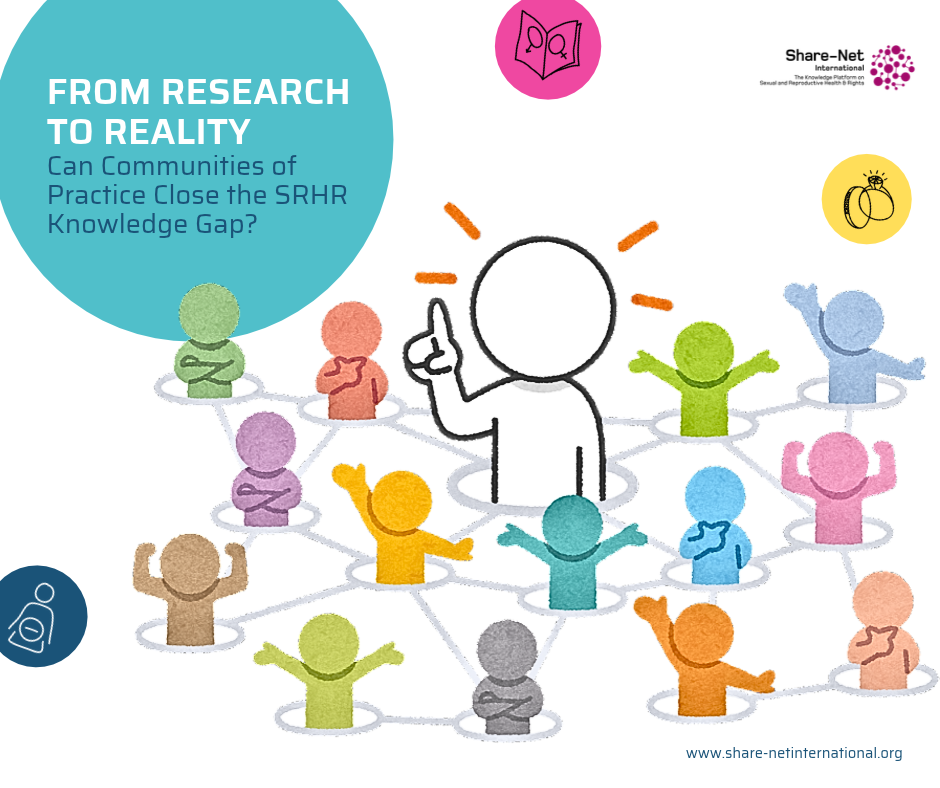
Research can reveal why people struggle to access sexual and reproductive health and rights (SRHR). But what happens after the findings are published? Do they reach the policymakers shaping services, the practitioners working with communities, or the young people whose lives they concern?
The distance between producing knowledge and putting it to use remains a challenge in public health. A new qualitative study examining Communities of Practice (CoPs) across eight Share-Net International hubs explores how collaboration can help bridge that divide, while highlighting the barriers that can prevent knowledge from translating into meaningful action.
More than a space for discussion
Communities of Practice bring together people with shared interests to exchange knowledge, learn from different experiences and work towards common goals. In SRHR, these groups can connect researchers, policymakers, healthcare professionals, civil society organisations and advocates who might otherwise work in separate spaces.
The Share-Net International study, based on research conducted between October 2024 and January 2025, found that CoPs can support context-specific knowledge creation, collaboration and the development of practical knowledge products. These activities can help make research more accessible and relevant to people who need to use it.
However, collaboration alone does not guarantee change. Political resistance, unequal power relations and limited resources can constrain what CoPs achieve. Gaps in dissemination and monitoring also make it difficult to determine whether knowledge products influence policies, improve programmes or change practices.
The challenge is not simply sharing knowledge
The World Health Organization’s 2026 global research agenda on knowledge translation and evidence-informed policymaking recognises that research evidence remains underused in health decisions. It calls for stronger understanding of what enables evidence use, what obstructs it, and how knowledge translation can become more effective and equitable.
For SRHR, these challenges carry particular importance. Evidence concerning contraception, adolescent health, gender-based violence and reproductive health services must navigate social norms, institutional priorities and political realities.
A research finding may be scientifically sound but still fail to influence practice if they do not reach the right audience, address local priorities or arrive in a usable format.
The study therefore raises an important consideration: knowledge translation is not a final communication step. It is an ongoing process shaped by relationships, resources and the environments in which decisions are made.
Collaboration requires accountability
The findings point towards locally responsive approaches, strong facilitation and cross-hub learning. Yet these need to be supported by realistic resources and monitoring systems that value learning, not simply activity counts.
WHO’s Evidence-Informed Policy Network similarly emphasises collaboration between researchers, policymakers and civil society, alongside efforts to adapt evidence to national health priorities.
For Share-Net International, the question is not only whether its Communities of Practice produce useful knowledge, but also how that knowledge travels beyond the network.
“Bridging the gap between knowledge and action” is ultimately a question of who gets heard, whose evidence is used and whether the resulting decisions improve people’s access to SRHR information, services and rights.
Communities of Practice can help create the connections needed for change. But their value will depend on whether those connections lead to decisions, services and practices that respond to people’s actual needs.