From One Million Voices to Policy: What Europe’s Abortion Decision Signals for SRHR
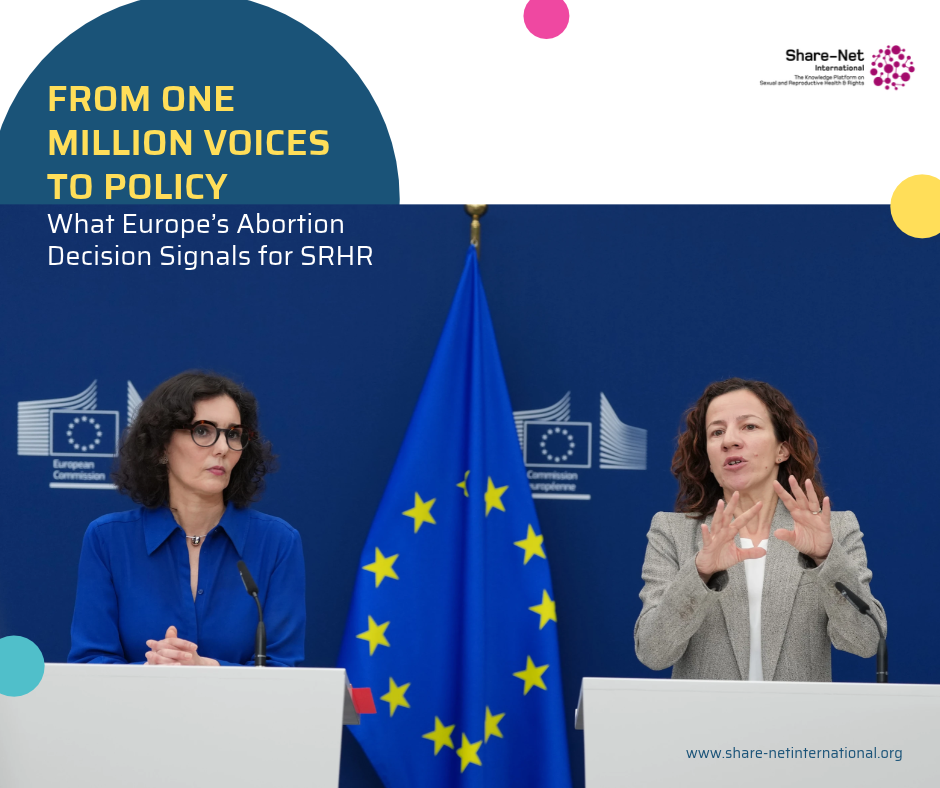
For many women, access to reproductive healthcare can still depend on where they live, how much they earn and whether services are available in their communities. A decision by the European Commission in February 2026 has brought that inequality into sharper focus, while opening a new pathway for cross-border abortion care within the European Union.
The Commission confirmed that EU member states may use the European Social Fund Plus (ESF+) to improve access to legally available, affordable and safe abortion services, including support for women who need to travel to obtain care. The decision followed the “My Voice, My Choice” European Citizens’ Initiative, which collected 1,124,513 verified signatures across the EU.
The move is significant because abortion access remains uneven across Europe. While countries such as France have strengthened legal protections, abortion remains highly restricted in several European states. For people facing financial hardship, geographic isolation or restrictive national policies, travelling for care can add another layer of cost and difficulty.
Importantly, the Commission did not establish a new EU-wide abortion fund. Instead, it clarified that existing ESF+ resources can be used voluntarily by member states and in accordance with national laws. Member states must therefore develop their own programmes and determine how support will reach those who need it.
That distinction has produced both celebration and debate. Supporters see the decision as recognition that safe abortion is connected to public health, social justice and equal access to healthcare. Critics argue that using an existing fund falls short of the dedicated mechanism campaigners originally sought and raises questions about the balance between EU-level action and national authority.
The development also reflects a broader trend within the global sexual and reproductive health and rights (SRHR) movement: access is increasingly being viewed not simply as a question of whether a service is legal, but whether people can realistically reach and afford it.
The European experience illustrates a wider challenge faced around the world. Laws, healthcare infrastructure, income, stigma, distance and social inequality can combine to create barriers even where services formally exist. The debate therefore extends beyond abortion itself to a fundamental SRHR question: does a legal right translate into meaningful access?
With more than one million citizens mobilising across borders, the “My Voice, My Choice” campaign also demonstrates the growing role of civil society in shaping reproductive health policy. Its outcome does not resolve Europe’s access gaps, but it has established a new policy pathway.
For the global SRHR movement, the significance may ultimately lie not only in the funding decision, but in the principle behind it: reproductive healthcare cannot be fully equitable when access depends heavily on geography, income or circumstance.