Beyond Billion-Dollar Pledges to Budget: Copenhagen Summit 2026 Focused on Financing the Future of Women’s Rights
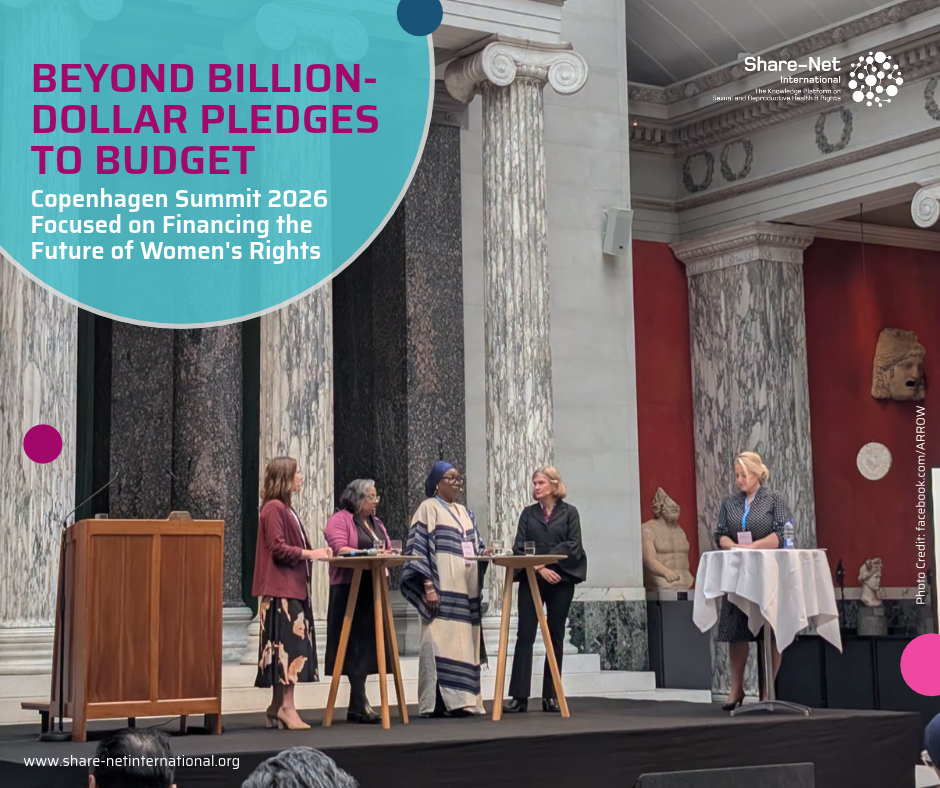
Sexual and reproductive health and rights (SRHR) have long been central to the global gender equality agenda. Yet, despite decades of international commitments, sustainable financing remains a persistent challenge. From access to contraception and maternal healthcare to comprehensive reproductive health services, progress depends not only on political recognition but also on whether resources reach the people and communities who need them.
This financing challenge took centre stage at the Copenhagen Summit on Gender Equality and Women’s and Girls’ Rights, held on 16–17 November 2026. Hosted by the Danish government and the Nordic Council of Ministers, the summit brought together hundreds of participants from more than 40 countries, including governments, international organisations, civil society and philanthropic institutions.
Against a backdrop of growing opposition to gender equality and declining global health financing, the gathering sought to build stronger international cooperation. Its most significant development for the SRHR movement was the launch of a new international financing partnership involving six governments and major philanthropic organisations.
A new alliance to address the SRHR financing gap
Denmark, Finland, Iceland, Norway, Sweden and South Africa launched the partnership alongside the Gates Foundation, the Children’s Investment Fund Foundation (CIFF) and Laerdal Global Health. Its central ambition is to mobilise additional resources and establish more predictable, sustainable financing for SRHR.
Rather than creating parallel funding institutions, the partnership intends to strengthen existing systems and encourage collaboration between governments, development partners, philanthropies and other stakeholders. It also aims to move beyond traditional donor-recipient relationships towards partnerships shaped by shared priorities and country-level needs. Progress is expected to be reviewed in 2030.
The initiative comes with substantial financial commitments. Nordic governments collectively contributed more than US$559 million to SRHR in 2025. Meanwhile, the Gates Foundation announced plans to commit up to US$1 billion through 2030 for family planning and women’s health, while CIFF pledged close to US$900 million. Together, the two philanthropic commitments represent more than US$1.9 billion.
The scale of these commitments reflects growing recognition of family planning as both a public health priority and an investment in gender equality. According to the Gates Foundation, more than 257 million women and girls who want to avoid pregnancy are not using a modern contraceptive method. The foundation argues that expanding voluntary access to contraception, alongside quality maternal healthcare, is essential to improving women’s health and autonomy.
The economic case is equally significant. Estimates presented by the Norwegian government suggest that every additional US$1 invested in contraceptive services saves approximately US$2.48 in maternal, newborn and abortion care costs. This makes sustained investment in family planning not only a rights-based priority but also a cost-effective public health intervention.
From international commitments to country-level financing
While the new partnership represents an important development, the Copenhagen discussions highlighted a longstanding concern within the global SRHR movement: announced commitments do not automatically translate into accessible funding.
At a roundtable titled SRHR Financing: From Pledges to Budgets, organised by FP2030, the Guttmacher Institute and the Partnership for Maternal, Newborn and Child Health (PMNCH), more than 50 participants examined fragmented funding arrangements, financial pressures and the limited influence of civil society organisations over resource allocation.
A shared civil society advocacy agenda, developed through consultations with more than 100 organisations, outlined four priorities: country-led financing rooted in national needs; a single, aligned financing plan; transparent funding data and accountability; and flexible, sustained support for civil society participation.
These priorities address a critical gap between global financing announcements and national implementation. Without stronger domestic ownership, transparent expenditure tracking and meaningful community participation, even substantial financial commitments may fail to address inequalities in access to essential services.
The agenda will be opened for partner endorsement ahead of Universal Health Coverage Day in December, providing an opportunity to build wider support for more accountable SRHR financing.
Making financing work for women and young people
For countries with constrained health budgets, including those in the Global South, the implications are particularly important. International financing must complement domestic investment, strengthen public health systems and support local organisations that understand the needs of their communities.
Young people, women-led organisations and grassroots networks also need meaningful roles in determining how resources are allocated and monitored. Financing must support accessible, voluntary and rights-based services rather than focus solely on numerical targets.
Copenhagen has provided renewed political momentum and a significant financial foundation for the global SRHR movement. However, the real measure of its success will be whether these commitments translate into stronger national budgets, reliable services and greater accountability.
Ultimately, sustainable SRHR financing is not simply about mobilising more money. It is about ensuring that resources reach the right institutions, communities and people, enabling women and girls to exercise their rights and make informed decisions about their bodies and futures.
Sources:
- https://fp2030.org/news/from-pledges-to-budgets-fp2030-advances-a-shared-agenda-for-sustainable-family-planning-and-srhr-financing-in-copenhagen/
- https://www.regjeringen.no/en/whats-new/new-international-partnership-invites-global-partners-to-join-forces-and-unlock-new-financing-for-sexual-and-reproductive-health-and-rights/id3193002/
- https://www.gatesfoundation.org/about/newsroom/press-releases/2026/11/family-planning-copenhagen
- https://www.norden.org/en/copenhagensummit